This isn’t a new recipe… in fact it’s just a re-hash of an old one. This one in fact. It’s just that it’s Christmas and these little Thumbelina morsels that originally housed cherry jam seemed to be crying out to be filled with mincemeat and topped with a red M & M and two antlers of broken pretzel.
So follow the recipe and once cool make eyes and a mouth with a toothpick, prod two pretzel antlers into the marzipan and use a little icing (I used one of those little icing pens from Sainsbos) to stick a red nose on your Rudolf. And then if you’re feeling like Rudolf might need a piggy pal then go wild and make some of these:
Apologies for the rubbish photo. They didn’t survive to see morning light or my big proper camera. Easy to make, more so than the reindeer. Just add a little marzipan nose and two flaked almond ears before you bake your pigs. Eyes and nostrils added after with a toothpick. Oink oink!
This is the stuff of dreams. Sometimes, just sometimes, the 6 year old only child in me creeps back to the surface and whispers in my ear, not to cut the shortbread but to leave it in one block and eat it all myself, whilst pretending to be a giant. Make this for people you care deeply about. Or just yourself if it’s a selfish kind of a day.
Ingredients:
– 250g soft salted butter
– 100g caster sugar
– 260g plain flour
– 90g cornflour
– 1 x 397g tin of caramel
– 200g white chocolate
– Malteasers, chocolate coins… do your worst
Very easy to make. Very easy to eat. Preheat your oven to 170C and line a 20cm x 20cm tin with sides at least 3cm high, with butter and greaseproof paper. (You can use a bigger tin but reduce the cooking time a little as the shortbread will be thinner and therefore will take a shorter time to cook.)
Take your soft butter and beat (in your stand mixer/with an electric mixer/by hand with a wooden spoon) until soft and creamy looking. Then add the sugar and beat again until all combined, light and fluffy. Add the flour and cornflour and beat until the mixtures comes together into clumps. Press into your prepared tin and bake for 20 – 25 minutes until lightly golden brown on the top. Don’t worry about opening the oven to check, shortbread doesn’t mind this at all.
Remove from the oven and leave to cool on a wire rack, in the tin. Once cool open your tin of caramel and pour over the top, using a spoon and knife to ease over the whole of the slab of shortbread. Leave to settle in the fridge. Melt your white chocolate very carefully in the microwave in 30 second bursts so as not to risk burning it. You can use the bain marie method instead if you prefer.
The best way to do this is not to pour in one place – pour it in sections so that you don’t disturb the set caramel. Use a teaspoon to push the chocolate gently over the caramel and then, whilst the chocolate is still molten, pop chocolate coins and Malteasers over the top, being careful to only pop them into ‘squared’ sections so that you can easily cut the slab of shortbread when completely cool and not have to saw a Malteaser or coin in half. Do clean the knife after each cut as it makes for cleaner looking slices.
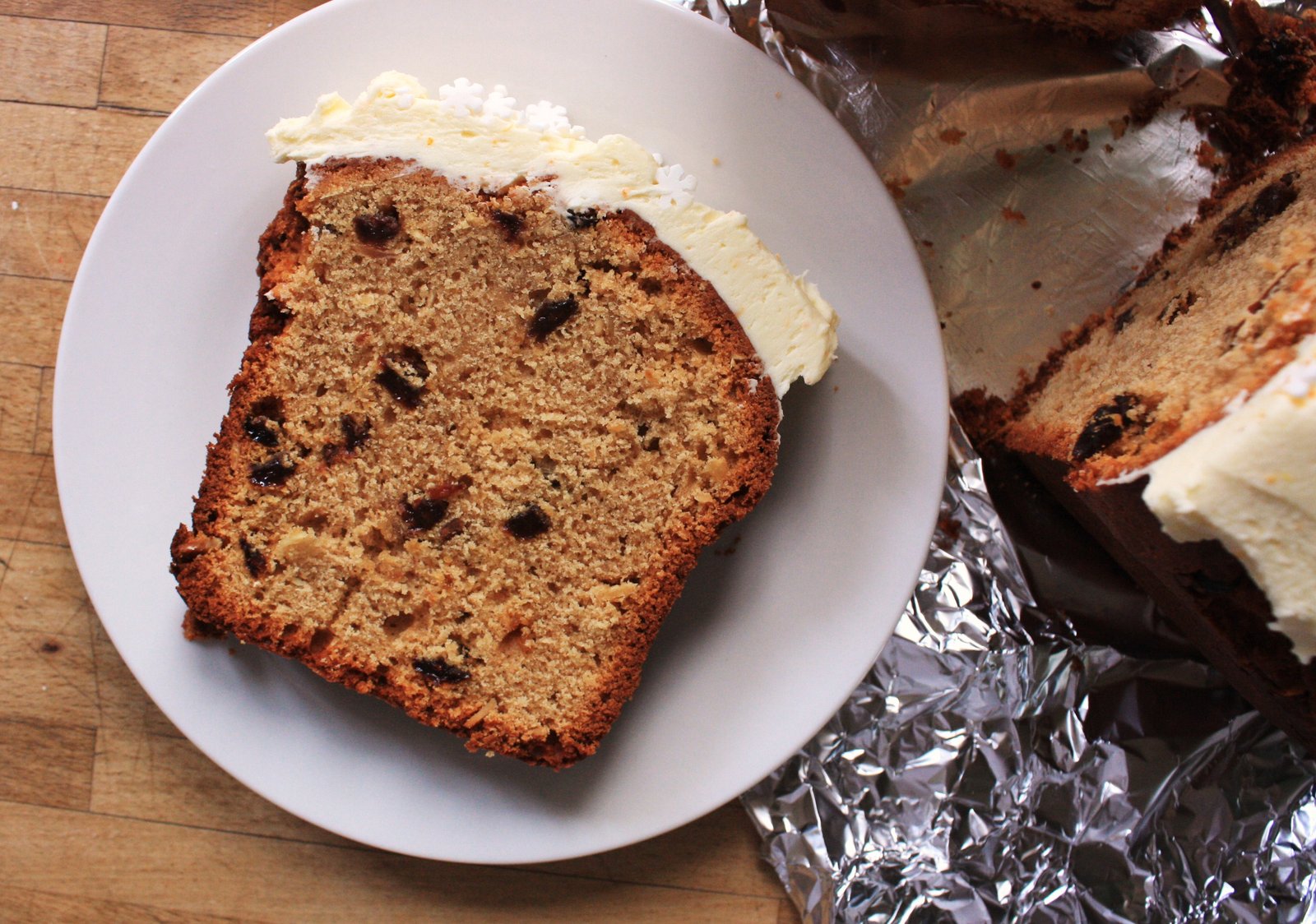
A Christmassy cake that doesn’t make your teeth itch from fondant icing, or break them with fondant’s posh Royal sister. An honest fruit loaf, flecked with toasted almonds, a hint of gingerbread and topped with the lightest fluffiest brandy butter inspired icing you ever sunk your teeth into. It doesn’t keep for long, but then it won’t have to.
Ingredients:
– 200g soft butter
– 200g soft dark brown sugar
– 400g self raising flour
– 100g sultanas
– 100g toasted flaked almonds
– 4 large eggs
– 4 tbsp milk
– 2 tbsp gingerbread syrup (if you don’t have it, substitute with more milk and 1 tsp ground ginger and cinnamon)
– 100g soft butter
– 245g icing sugar
– Zest of 1 orange
– 15mls brandy
This recipe makes a monster of a fruit loaf, big enough to fill a tin that measures 25 x 11 x 7cm. If you prefer your cakes on the dainty size then please feel free to halve the quantities. Look how big it is!
Preheat the oven to 180C/Gas 4 and grease and line your loaf tin. Cream 200g butter with the soft brown sugar until creamy looking. Takes about 4 minutes using an electric mixer or about 10 minutes by hand with a wooden spoon. Then add the flour and mix again until you have a dry breadcrumby consistency. Next add the fruit and nuts (which you can substitute for whatever you like but please do toast whatever nuts you add as it makes all the difference to the end result.)
To your very dry looking crumble type mixture add all 4 eggs, the milk and the gingerbread syrup if you have it. Mix well until all combined then smooth into the loaf tin and bake in the centre of the oven for about an hour and 15 minutes until a skewer comes out of the centre of the loaf clean. Do check it from 50 minutes onwards though as all ovens are very different. If it looks like it’s browning too quickly on the top but is still raw inside then feel free to fashion a foil hat for the top of the cake to protect it.
Leave to cool on a wire rack. Make the brandy butter icing by creaming 100g soft butter with the zest of an orange and the icing sugar. Once really fluffy (7 mins top speed in a stand mixer or at least 12 minutes with a wooden spoon) add the brandy and mix again.
Spread onto your cooled cake and add any decorations you fancy. Keeps for 5 days in an airtight tin or freezes very well without the icing too.
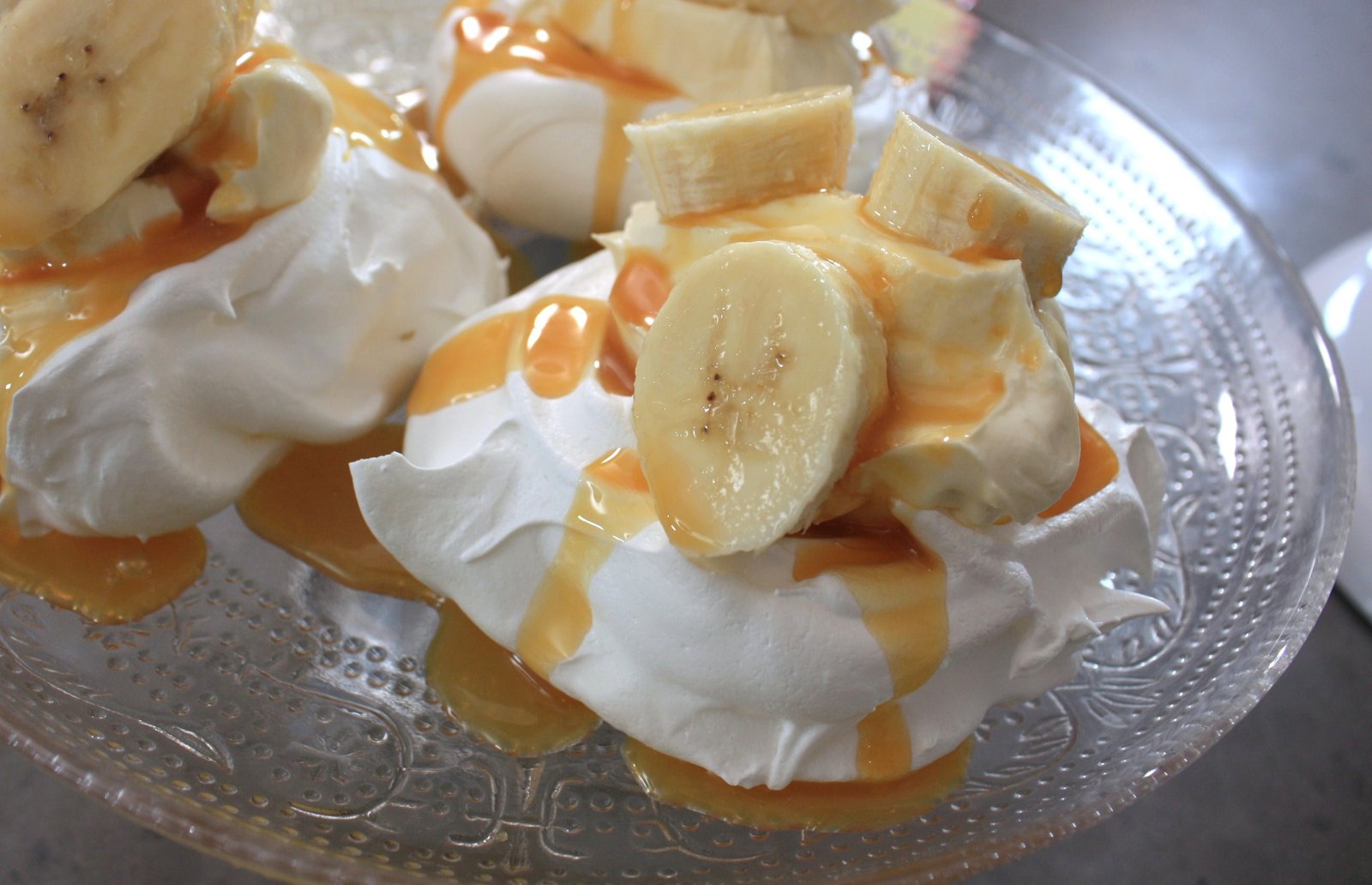
Essentially a very lazy recipe… just follow the recipe for this to make the pavlovas. Then add 200g whipped double cream, some sliced bananas and if you feel inclined you could make you own toffee sauce. Or you could just buy one. This is a Friday night pudding for when you need maximum gratification and minimum effort. Make the meringues on a Wednesday and you may just fall in love with yourself come Friday dinner time.
I heart toffee sauce. Look at this stuff. If you want to make it then this recipe is very good. Good old Mary.
I’m going to have to hold my hands up in the air and declare a truth. I’m not one of those girls who’s mad on meringue. It’s not that I don’t like it. It’s kind of hard not to like. It’s more that I can always find other things on a menu I prefer. However I have married into, and now given birth to, a family of meringue fiends. So it is very much in my interest to create new meringue based recipes each year. Though let’s be honest, a good old Eton mess always goes down well when the fridge is a little bare.
Makes about 10 but all depends on the size of the nests.
Top tip: make these just before you go to bed so the meringue can cool to room temperature VERY slowly and thus avoid cracking in a volcano like fashion.
Ingredients:
– 120g egg whites (about 4 but depends on size of your eggs)
– 200g castor sugar
– 5g cornflour
– 5mls white wine vinegar
– 1 x tin chestnut puree
– 50g raisins
– 30mls brandy
– 200g double cream
Whisk your egg whites until beginning to hold their peaks. Then whisk in 1 teaspoon of the castor sugar at a time. I know this is laborious but if you rush it and throw the lot in you’re less likely to make sure it all dissolves into the egg and you might end up with weeping meringue. Might.
Once the sugar’s all in, the mixture should look really white and glossy, then add in the cornflour and white wine vinegar. Whisk again. The combination of these ingredients makes for a mallowy chewy middle to your meringue so whilst they’re desirable they’re not a reason to run to the local shops if you don’t have them.
Pop some foil or baking parchment on a baking tray, fixing it down with a little sticky meringue. Then spoon about 2 heaped tablespoons of the meringue onto the foil/parchment to make each nest. You can leave in a big snowy heap or use your fingers and the back of a teaspoon to slightly hollow out the middle for holding double cream later. Up to you. (You can squash the meringues after baking instead to make a pocket for the cream if you prefer, but they will crack as you do this.)
Then bake at the bottom and on the middle shelf of a preheated oven at 140C. (For these are the coolest areas of most ovens and we’re trying to dry these meringues out, not bake them so that they brown.) As soon as they go into the oven turn it down to about 100C, or 90C for a fan. Then after 45 minutes turn the oven off entirely but don’t open it.
About 35 minutes into baking I tend to open the oven door and have a little prod to make sure the oven has worked it’s magic and the outsides of the meringue are hard. If not they need a little longer than the aforementioned 45 minutes. Then I DO NOT OPEN the oven for the last ten minutes of baking. I turn the oven off and then leave the little snowy meringues to slowly come to room temperature for a few hours. Easier to just make these last thing at night and leave them until the morning in your oven.
Once completely cold I fill with whipped cream, pipe a little chestnut puree on top and then crown with raisins I have soaked in brandy by heating them gently on the stove and letting them come to room temperature. But you can top with anything you like. The unadorned meringues last for 3 days or so in a tin at room temperature so you can easily get ahead with this easy pud. Don’t forget to add any broken meringue to vanilla ice cream along with some lemon curd and crunched up digestives. Lemon meringue ice-cream is too much of a joy to be missed.
Lemon drizzle is one of my favourite cakes to eat and make. A very good friend of mine doesn’t like lemon related sweet treats and I have to say, when I found out, she went down in my estimations slightly. I just don’t understand.
Lemon drizzle seems to be divided into two camps; those with a crunchy topping and those without. I prefer those without, the drizzle of my dreams is soft, tart and saturated in lemon sugar syrup without leaving crystals of sugar on the top. Here’s how I do it:
Ingredients:
175g margarine/soft butter
175g caster sugar
3 eggs beaten
zest of 3 lemons BUT NOT THE PITH!
3 tbsp whole milk
175g self raising flour
juice of 3 lemons
50g caster sugar
Grease and line a 20 x 20cm tin with greaseproof paper. I line like this. Use whatever size tin you have to hand, for a larger pan the bake time is usually less as the cake is less thick. For a smaller tin the bake time is usually longer. You’re looking for the edges of the cake to be pulling away from the sides and for a skewer to come out of the centre clean.
Preheat the oven to 170C. Check the rack is in the centre of the oven. Cream the margarine/butter with 175g caster sugar until really light and creamy. Takes about 4 minutes in a stand mixer. Add the beaten egg gradually, dribble by dribble. Then add the zest and the milk. Worry not if the mixture curdles. Fold in the flour with a metal spoon, pour into your tin, level with the back of a spoon and bake for 20 – 25 minutes until golden on the top and a skewer comes out clean from the middle.
Leave to cool slightly on a wire rack still in the tin and then make the sugar syrup by heating the juice of 3 lemons with 50g of caster sugar for about 2 minutes until the sugar dissolves and is just starting to bubble away. Poke lots of holes in your cake with a skewer and pour the syrup over the top, being careful not to let it all seep down the sides and drizzle the bottom of your cake only.
Then (now this is the important bit), lay out a large piece of foil, then on top of it a large piece of greaseproof paper – they need to be big enough to use as wrapping paper for your cake. Pick your drizzle cake up by the greaseproof paper it sits on in the tin and move to your wrapping paper. Then wrap your cake carefully, using the foil to fold the edges over. Leave the cake to cool like this. The heat of the cake and the lemon sugar syrup combine to create the most moist, zingy lemon sponge. Just the way I like it.
I know. I’m as bad as all those retailers decking the aisles with tinsel in August. I just can’t help it though and I don’t care who knows it. I love Christmas. I love it! I want to live in a festive schmaltzy film. I want to wake up on the 25th December and find the Santa sack from my childhood nestled at the end of the bed fit to bursting with chocolate coins and maybe even a pink snail Keeper toy. I want flapjack covered with a layer of mincemeat and grated marzipan in October. Well okay then.
Ingredients:
175g butter
75g brown sugar
30g golden syrup
Pinch of salt
175g oats
25g rice crispies
100g sultanas
Half a jar of mincemeat
Half a block of marzipan, cold from the fridge
I basically followed an old faithful flapjack recipe but you should use your favourite. Pop the oven on at 140C or whatever your recipe says. Then I melted the butter, sugar, syrup and salt in a saucepan (careful measuring out too much syrup, your flapjack won’t hold a slice as well) until just about to bubble. Next I added the oats, rice crispies and sultanas and gave the lot a good stir until completely covered.
I tipped into a silicone tray (so I could avoid any lining activity) that measures about 20 x 24cm and flattened with a metal spoon until level. Then I very carefully spread half a jar of mincemeat (I used ready made stuff this time but I will most definitely be making my drunken cherry brandy mincemeat very soon) on the top of the flapjack – just a very fine smear, not huge dollops of the stuff. Careful the knife doesn’t rip through the delicate uncooked oats. On top of that I grated half a block of cold marzipan (grates better when colder, use the course side of the grater) and then baked for 30 minutes until golden brown on top. It looks like a pie topped with grated cheese pre baking. Do not be alarmed.
Leave to cool in the tray and only cut when cold or it all falls apart on you.
I enjoyed mine whilst writing my day dream Christmas list.
I’m a bit of a late adopter with some things. I was almost a teenager when I learnt to ride a bike. I only recently got my first iPhone and even then it was a donated one. And I had never eaten, let alone made a cake pop until recently. Unlike the bike riding, I think the cake pop addiction is a habit here to stay. I am ever faithful to all things novelty.
Here are a few good tips I’ve found through trial and error to make perfect (well almost perfect) pops. This makes about 13 pops.
Take your leftover cake. If you are going to eat the cake pops within a couple of days then you can use your own homemade cake. If you want a little longer shelf life then buy one of the value blocks of Madeira cake from a supermarket. Usually has a good few weeks on it. I know, I know, homemade is best, but if I don’t say it someone will ask. As for flavours and types of cakes, I tend to use leftover vanilla cupcakes using a basic sponge recipe, however you can use any flavour you like. I haven’t tried fruit cake yet but I assume it would work okay. Just be careful of the weight of the pop. More on that later.
Use your fingers to break the cake up into breadcrumbs. You need a light touch rather than a squeezing touch. You can also use a food processor or the flatbeater in your stand mixer. I tend to use my hands as I don’t make cake pops in huge quantities. Leave your cake crumbs in a large bowl and then add your buttercream. (If you do make too much cake pop mixture then freeze at the ball stage and you’ll have more pops for a rainy day. A great tip from Jo.)
I use the old fashioned half butter (salted if you’re interested) to icing sugar buttercream recipe with a good tablespoon of vanilla extract, beaten in my stand mixer for 7 minutes until light and fluffy. However, for cake pops you really don’t need light and fluffy buttercream. So if you’re making buttercream especially for cake pop purposes then I would probably use a wooden spoon. You can use any flavour buttercream by the way… much like with the sponge.
Add the buttercream to the cake crumbs one tablespoon at a time and give the mixture a good stir. All cakes bind with buttercream differently. What you’re looking for is the cake to come together with the buttercream into a thick spread like consistency that will hold a shape. Too dry and the cake pop will crack whilst it’s chilling. Too wet and the buttercream will melt when you dip in the Candy Melts. Test it by taking a tablespoon of mixture and scrunching it up with your fingers. It should hold easily and then be happy to be rolled between your palms. Cover the mix with clingfilm and then refrigerate for about 30 minutes. If you haven’t make cake pops before add one teaspoon of buttercream at a time. You can add, but you cannot taketh away.
After 30 minutes you can start to roll your cake truffle mixture into balls about 2.5cm across between the palms of your hands. Any larger and you run the risk of the weight of them dragging them off the stick when dipping. Oh and don’t add oil to your hands or anything else to stop it sticking, just go with it. Once rolled, pop on a plate lined with greaseproof paper or back into the bowl you chilled the cake pop mixture in and either put in the freezer for 20 minutes or if you don’t have room in your freezer (my hand is firmly up) then cover and pop back in the fridge for an hour. You don’t have to shape your cake pops into balls of course, you can instead shape into cones to make Christmas trees or Santa hats. Whatever you fancy really. Here’s a little film to show how:
A few minutes before you’re ready to start to dip and decorate your pops, melt your Candy Melts. I use the microwave in 20 second blasts – the packets have all the instructions. If you do overheat them they seem to lose their shine when dry. Instead you could melt the Candy Melts over a pan of simmering water instead to control the temperature better. Make sure whatever you end up transferring your melts to that the receptacle is small enough in width to allow the Melts to have a little depth. You need to have something to dip into. (I know some of you will prefer to use chocolate to dip your pops into… I have found it less easy as it takes a little longer to dry. You just need a bit more practice I guess.)
Find something to rest your still wet pops in to allow them to dry. I use an upturned meatball griller (!) but you could also use a block of polystyrene with holes poked into it, an egg box with yet more holes poked into it or an upturned colander if the holes are big enough. Dip a lollipop stick about half a centimetre into the melted Candy Melts and then push the stick into the rolled cake pop until it’s just over half way in. Set aside and allow about a minute to dry. This stage is important as it stops the cake balls from falling off the sticks later.
I tend to get all the sticks into the cake balls first. It makes best use of the dry time required. It also makes sure your Candy Melts aren’t so hot that they make the cake expand and crack through the dried Candy Melts shell once you dip the whole cake ball. Using boiling hot Melts to dip cake into ends in cracked pops and possibly tears. (If it does happen just allow the pop to set and then dip again as if starting with a nude cake ball. Just a thicker coating but better than trying to patch the cracked pop up.) Here’s a little film of the whole process from stick dipping to sprinkling: (If you prefer to read instructions then they’re all below the film along with some pop-pics.)
Then take the stick with the nude cake ball now attached to it and dip into the melted Candy Melts. Don’t start to swish it about as it’s likely to fall off. If your receptacle isn’t deep enough to cover all of the cake ball then use a teaspoon to bathe the cake ball in Candy Melts, gently pushing it over the cake ball. Then use the stick to pick the cake pop up and hold the stick against the side of the dish and tap very gently encouraging the excess Candy Melts to fall back into the dish. You can turn the pop as you do this to ensure you don’t end up with a peak drying where the Melts drip into the dish.
Using Candy Melts is very easy but it’s different from chocolate as it dries more quickly. Either allow to dry by carefully placing the stick into your drying rack of choice or take this opportunity to hold the pop over an empty dish and sprinkle anything you fancy over the still wet pop. You can use a toothpick or fork to make a spikey cake pop if you like by pulling at the Candy Melts covering as it dries. You could also allow the pop to dry with one coating and then use an icing bag to dribble another colour over the pop… the possibilities are endless. Oh and you can even melt your Candy Melts into a disposable icing bag in the microwave, just balance in a jug.
P.S. For those who might ask the Reindeer and Santa faces are from Sainsbury’s, as are the red, white and green sprinkles. The holly leaves and berries are by Wilton (though you can get similar from Sainsbos) as are the little white snowmen on top of the Christmas tree pops. The holly leaves were attached using a white icing pen, the type you buy that comes with nozzles to just attach to a toothpaste type tube. Lastly if you have Candy Melts leftover you can allow them to dry, seal in a bag and then re-melt again the next time you need them. They don’t get upset by repeated remelting like chocolate does. (Same goes for if you’re a slow-dipper and they get too solid half way through the process, just re-heat.)
I love Autumn, in fact I love Winter too. Spring’s good. Summer I am shy of. It’s the need to bare flesh and drink white wine rather than red that just doesn’t sit too well with me. But Autumn with your ’70s brown and orange colour scheme and your leaving the house cold air slap in the face and your chin skimming scarves and your comfort blanket roast dinners and your warming, lip staining red wine and your scalding crumbles and your crack and crunch toffee apples and your oohs and aahs at the fireworks that last all of 2 minutes. Autumn, I love you.
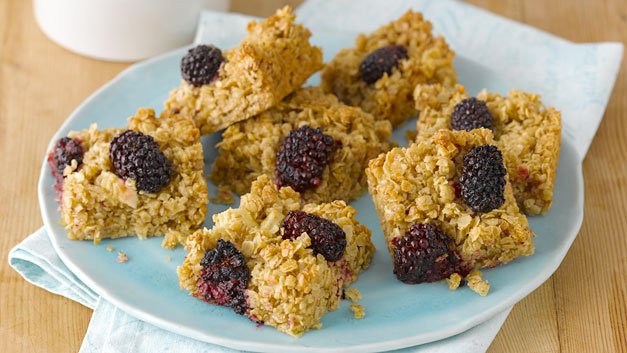
Is there anything more Autumnal than oats, apples and blackberries? Here’s a little video I made with Sainsbury’s of these flapjacks. I *may* have taken two trays home from the shoot. They were that good.
Ingredients:
150g salted butter, cut into cubes
75g demerera sugar
120g golden syrup
300g porridge oats
50g apple, cut into chunks
100g blackberries (fresh or frozen)
Preheat the oven to 180°C, fan 160°C, gas 4. Grease a 20cm square baking tin and line with baking parchment.
Melt the butter, sugar and golden syrup together in a large saucepan. Stir in the porridge oats and fold through the apple and blackberries.
Pour into the baking tin and bake for 25 mins until golden. Cut into 16 squares while hot and then leave to cool in the tray.
If you like flapjacks but want to make your mix go a bit further you can save money by making these flapjack balls. (Also loved by kids, it might be their miniature nature.) Or if you want to make your flapjacks a little bit different adding jam to the middle is delicious. And my favourite alternative to regular flapjacks has to be this no bake version using muesli, butter and toffees. It’s very easy and very moreish. Dangerous!
Sometimes you shouldn’t ask questions in case you get the wrong answers. I once voiced a concern to an ex that I was carrying a good stone too much weight. He went on to agree and tell me in detail about how my back had the potential to look great if it weren’t so fat. That was Fat-Back Gate. Then there’s the time I asked my husband if he liked my semi vegetarian creation ‘Carrot Stew with a hint of Chicken.’ He called for a takeaway. That was and still is Carrot-Stew Gate.
Then I asked the lovely people on my facebook page and on Twitter what kind of brioche they thought I should make for the blog. So many amazing ideas. Many chocolate related. Though here I am posting a lemon recipe. I can only apologise. I somehow think this won’t become Lemon-Brioche Gate. These are that good.
Makes about 12
Ingredients:
1 tbsp castor sugar
3 tbsp water
7g sachet of yeast
1 tbsp castor sugar
Pinch salt
2 eggs
200g plain flour
Zest of 1 lemon
90g soft butter
An egg yolk
I make this in my Kitchenaid but you can make it by hand if you like. It’s very sticky though and hard work. It can be done.
Take the first tbsp of sugar and put in a saucepan with the water on the stove. Heat until dissolved. Then leave to cool a tiny bit until you can dip your finger into it. Then add the yeast and leave for 10 mins until it smells hoppy and beery. It may well be frothy.
Then pour the lot into your stand mixer and add the last tbsp of sugar, give it a mix with the dough hook, then add the salt and eggs, again mix with the dough hook. Then add the flour and mix for about 4 minutes. Lastly add the zest and the mix again – then whilst it’s mixing add the soft butter a teaspoon at a time until it’s all combined. Take the bowl off the Kitchenaid, over in clingfilm and leave on the side for about 1.5 – 2 hours until the dough has doubled in size.
When it has pop back in the mixer and give a 30 second mix to knock the dough back. Then cut into 12 pieces with scissors. It’s very sticky so have a little pot of flour on the side for dipping your fingers into. Then shape the brioche. I do this by taking the piece of dough (ie/ one of the 12) and cutting off a small piece about the size of my thumb nail. This is the bit to go on the top, the kind of ‘nose’ of the brioche. Then I take the rest of the piece of dough, roll in between lightly floured palms into a ball, then put on the work surface and pop a floured finger into the middle and move my finger about in a small circle quite fast to push all the way through until I have a doughnut shape. Then pop this into a buttered mini brioche mould (I use the ones that are about 5cm across from ebay – search under ‘cake moulds) and add the saved ‘nose’ to the top.
When you’ve made all 12, pop on a baking tray and cover loosely with a floured tea towel. (Not a damp one! This lowers the temperature of the air near the brioche as it drys out and makes the rise time too long.) and leave to proof for about another hour or until doubled in size. Paint the brioche with egg yolk and then bake in a preheated 200C oven for 15 – 20 minutes until brown and risen. The kitchen will smell of lemony cake. Eat warm or cold for breakfast. Oh and you can leave the proofed brioche in the fridge overnight, let it come to room temperature and then bake first thing. My boys are rather partial to these as a treat on a Sunday morning.
I’m a mum of 3 boys, a cookbook writer and also a finalist on the 2011 Great British Bake Off.
I’ve decided to record the recipes I use, partly to save them somewhere and partly in case someone else might like to use them...
[Read more]
Just sign up to receive my latest blog posts straight to your inbox: Simply click here.
P.S. To sign up for my free monthly newsletter just click here. It has a baking SOS, recommendations on bits of kit I can’t live without, my kitchen catastrophe of the month, a sneak preview of a recipe coming up on this blog and a letter from me telling you what I’ve been up to.
Remember to check your inbox for a confirmation email and also to add my email recipesfromanormalmum@gmail.com to your contacts. Otherwise I could go to spam.













 Holly Bell